Repeat customer rate is one of the clearest predictors of long-term profitability for a small business, and the numbers back it up. A 5% improvement in customer retention can increase profits by 25% to 95%, according to Bain & Company research published in Harvard Business Review. That’s not a rounding error - it’s the difference between a business that survives and one that thrives.

Key Takeaways
- Repeat customer rate measures the percentage of customers who buy from you more than once in a given period, and it’s one of the strongest early indicators of small business health.
- The basic formula is: (Number of returning customers ÷ Total number of customers) × 100.
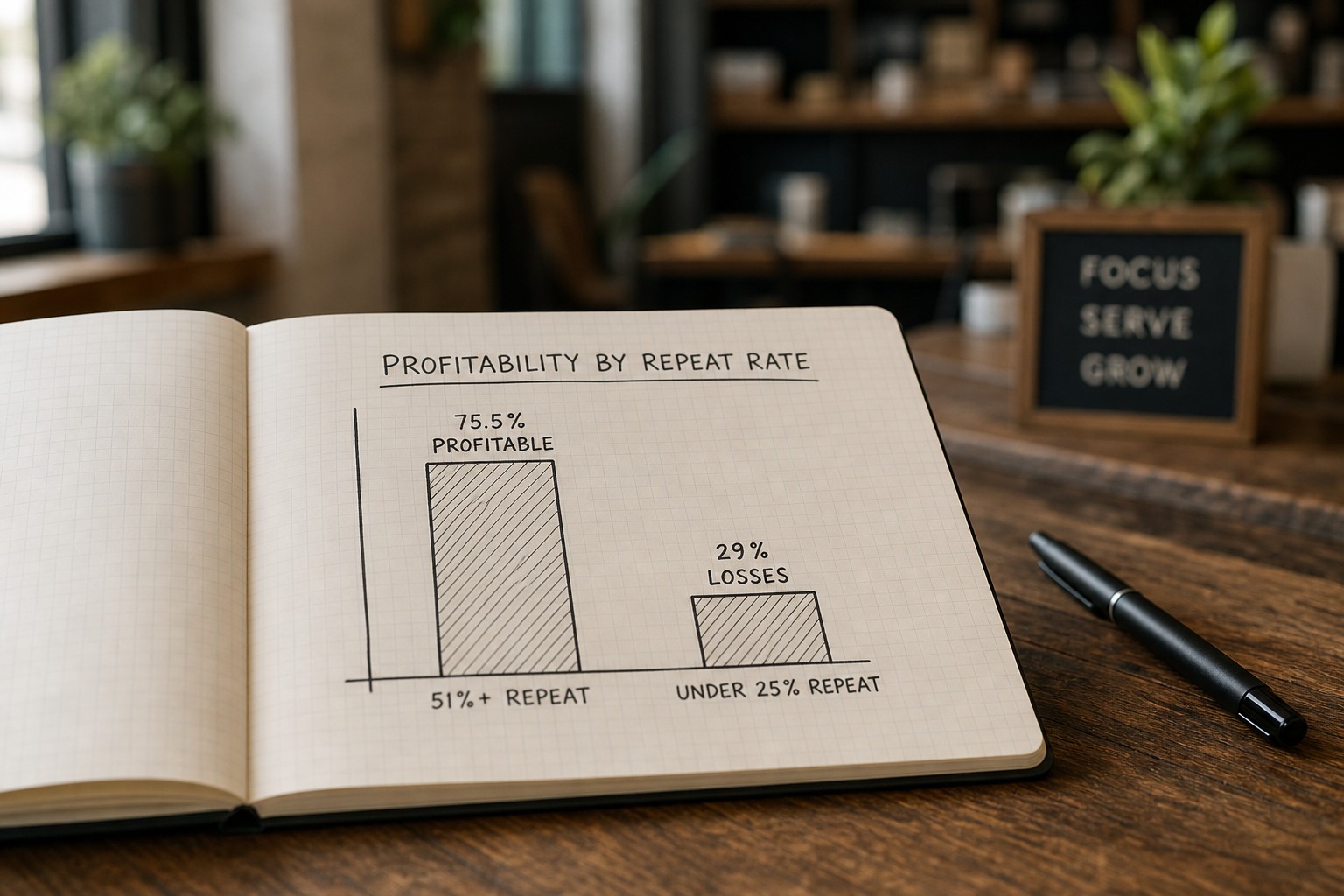
- Businesses generating more than 51% of revenue from repeat customers report a profitability rate of 75.5%, compared to just 43.4% for businesses under 25% repeat revenue - Small Business Expo Research.
- The main levers that move repeat customer rate are loyalty programs, service quality, proactive communication, and convenience.
- Repeat customer rate is closely related to but distinct from customer lifetime value (LTV) and customer churn, both covered in our complete guide to customer retention for small business and its companion articles.
- Small, practical changes (a simple digital loyalty card, a follow-up message after a first visit, faster service recovery) can start moving the number within 30 days.
- You don’t need enterprise software to track this. A digital loyalty card system can capture the data automatically as part of everyday transactions.
What Is Repeat Customer Rate and Why Does It Matter for Small Business?
Repeat customer rate is the percentage of your customers who come back and purchase from you again within a defined time period.
It’s different from total sales or foot traffic. A cafe could see 200 people walk through the door in a week and still have a weak repeat customer rate if only 30 of them are regulars.
For a small business, this metric matters more than almost any other retention number because it’s a leading indicator. Revenue, profit, and customer lifetime value all lag behind it. If your repeat customer rate is falling, you’ll usually see it months before it shows up in your bank balance.
How to Calculate Repeat Customer Rate (Formula and Worked Example)
The formula is straightforward, and you can calculate it with data most small businesses already have in their point-of-sale system or booking software.
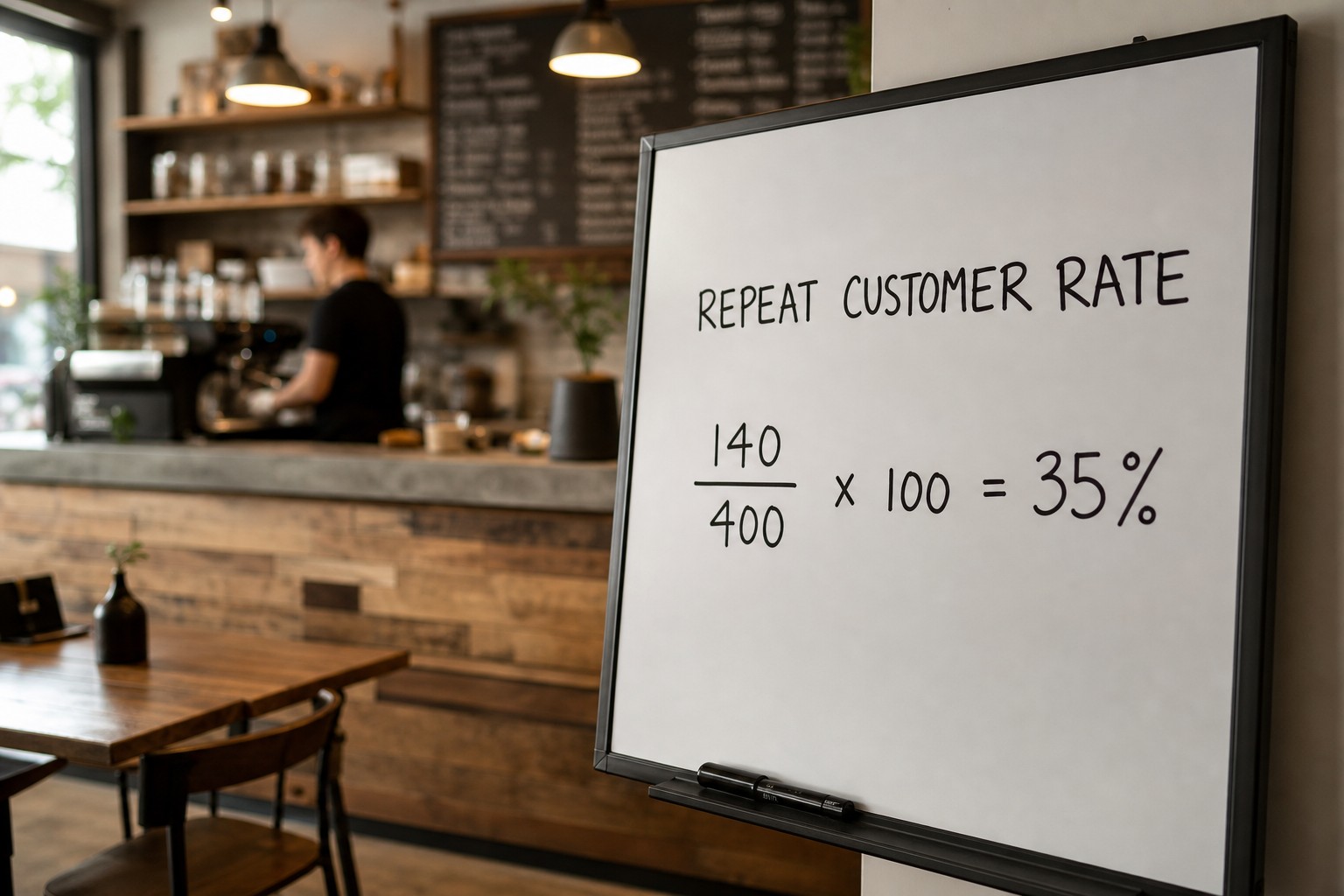
Repeat Customer Rate = (Number of Returning Customers ÷ Total Number of Unique Customers) × 100
Here’s a worked example using a hypothetical suburban hair salon over a three-month period.
- Total unique customers served: 400
- Customers who booked more than one appointment in that window: 140
Repeat customer rate = (140 ÷ 400) × 100 = 35%
That means 35% of the salon’s client base came back at least once during the quarter. The remaining 65% were one-off visits, which is where most of the growth opportunity usually sits.
You can run this calculation weekly, monthly, or quarterly. Monthly tends to work best for most small businesses because it’s frequent enough to spot trends without being noisy.
Why Repeat Customer Rate Matters for Small Business Profitability
Repeat customers don’t just spend money again - they spend it more efficiently.
Acquiring a new customer costs businesses roughly 5 to 25 times more than retaining an existing one, according to the same Bain/HBR research. On top of that, customer acquisition costs have climbed roughly 60% over the past five years, per Innovision Marketing Group’s compiled retention data.
That combination - rising acquisition costs plus a large retention discount - is why so many small business owners are shifting budget away from constant new-customer chasing and toward keeping the customers they already have.
Existing customers generate around 65% of a typical company’s revenue, rising to as much as 80% for businesses trading more than five years. Source: Invesp / BIA Advisory Services / Gartner, compiled via Innovision Marketing Group
This is also why repeat customer rate deserves a seat next to metrics like customer lifetime value when you’re reviewing business performance. A rising repeat rate is usually the first sign that lifetime value is about to climb too.
What’s a Good Repeat Customer Rate? Benchmarks for Small Business
There’s no single universal benchmark, because repeat customer rate varies enormously by industry, purchase frequency, and price point. A coffee shop should expect a far higher repeat rate than a bridal boutique, simply because coffee is a daily habit and wedding dresses aren’t.
One of the clearest real-world data points comes from Small Business Expo Research, which surveyed more than 1,100 small business owners on how repeat-customer revenue relates to profitability:
- Firms where more than 51% of revenue comes from repeat customers report a 75.5% profitability rate, with only 7.7% reporting losses.
- Firms where repeat customers make up less than 25% of revenue report a 29.0% non-profitability rate - nearly one in three.
- That’s roughly a fourfold gap in reported losses between the two groups.
The takeaway is simple: businesses that lean heavily on repeat customers are dramatically more likely to be profitable than those that don’t. The survey’s authors are careful to note this shows correlation, not proven causation, but the pattern is consistent with the broader retention research from Bain and HBR cited above.
If your current repeat customer rate is sitting under 25%, that’s not a reason to panic, but it is a reason to prioritise retention work over the next two quarters.
The Four Main Levers That Improve Repeat Customer Rate
Once you know your baseline, the next question is what actually moves the number. In practice, it comes down to four levers.
1. Loyalty Programs
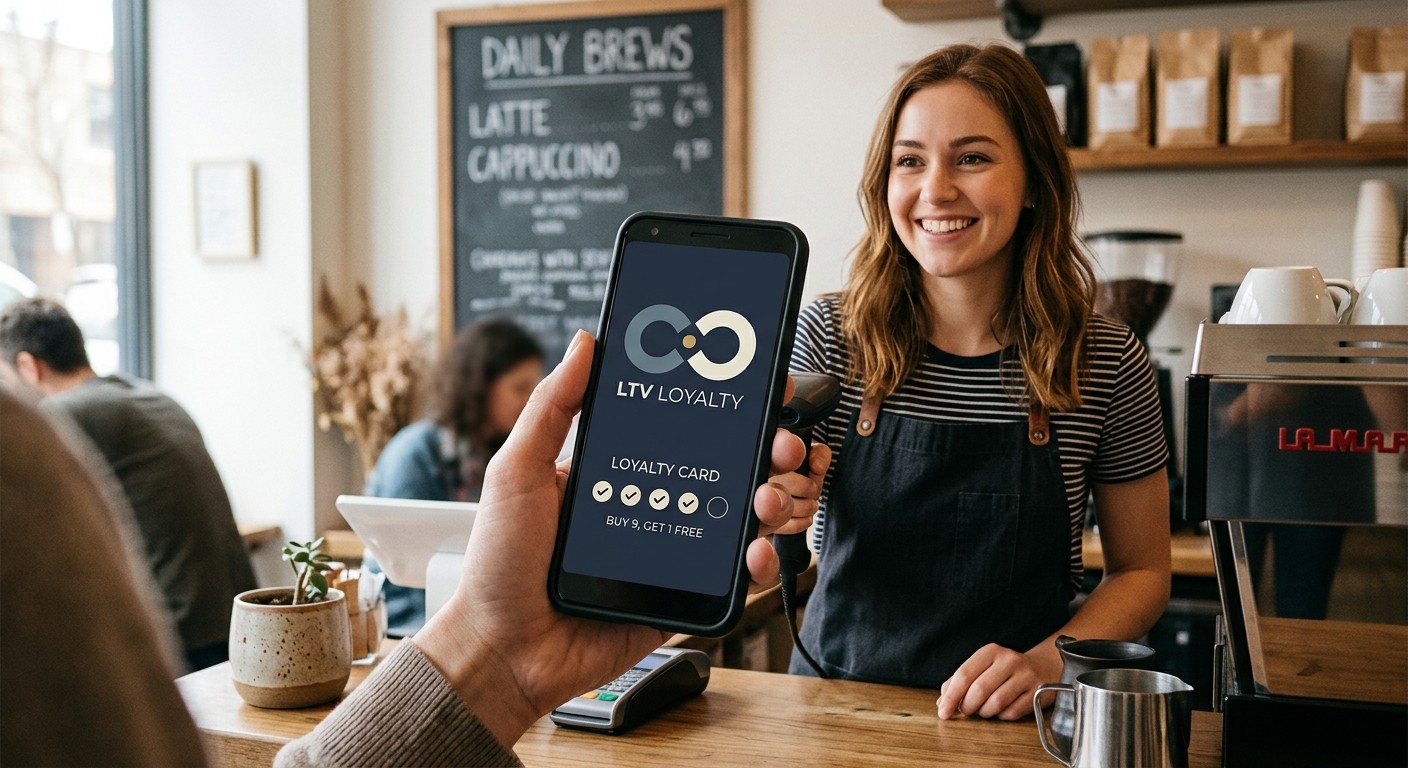
A structured loyalty program gives customers a tangible reason to choose you over a competitor next time, rather than relying purely on goodwill. Digital stamp cards and points systems work particularly well because they’re visible every time a customer opens their phone, unlike a paper punch card sitting in a drawer at home.
LTV Loyalty’s card and CRM features are built specifically so small businesses can set this up without needing a developer or a large marketing budget.
2. Service Quality and Consistency
52% of customers will switch to a competitor after just one negative experience, according to Zendesk’s CX Trends 2025 report, cited via Innovision Marketing Group. That single data point should reshape how you think about staff training and service recovery. Consistency, not occasional brilliance, is what brings people back.
3. Communication and Win-Back Outreach
Customers who haven’t heard from you in three months are far less likely to think of you when they’re ready to buy again. Simple, well-timed communication (a re-order reminder, a “we miss you” message, a birthday offer) reactivates customers who might otherwise have quietly drifted away. See our dedicated guide on win-back campaigns for a full playbook.
4. Convenience
Friction kills repeat business. If booking again, reordering, or redeeming a reward takes more than a few taps, a meaningful share of customers simply won’t bother. This is where digital loyalty tools outperform paper-based systems - customers don’t need to remember to bring a card, because it lives on their phone.
How to Improve Repeat Customer Rate This Month: Steps for Small Business Owners
You don’t need a twelve-month strategy to start moving your repeat customer rate. A handful of practical changes can produce measurable results within a few weeks.
- Calculate your current rate. You can’t improve what you haven’t measured, so start with the formula above using last quarter’s data.
- Segment your customer list. Separate one-time buyers from repeat customers so you can target each group with different messaging.
- Launch a simple digital loyalty card. Even a basic “buy 9, get the 10th free” structure gives customers a reason to return. See how it works in a few simple steps.
- Follow up after the first purchase. A short thank-you message within 48 hours, ideally with a small next-visit incentive, meaningfully increases the odds of a second visit.
- Audit your service recovery process. Given that over half of customers leave after one bad experience, make sure staff have a clear, quick way to fix problems on the spot.
- Reduce friction at checkout. If redeeming a reward or booking again requires an app download or a login, you’re losing customers to convenience alone.
- Review the numbers monthly. Set a recurring reminder to recalculate your repeat customer rate and compare it against the previous period.
None of these steps require a large budget. Most small businesses can implement the first four within 30 days.
Repeat Customer Rate vs Other Retention Metrics
Repeat customer rate doesn’t operate in isolation. It sits alongside a handful of other numbers that, together, give you a complete retention picture.
| Metric | What It Measures | Where to Learn More |
|---|---|---|
| Repeat Customer Rate | Percentage of customers who buy again within a set period | This guide |
| Customer Lifetime Value (LTV) | Total revenue a customer generates over the entire relationship | LTV guide |
| Customer Churn | Rate at which customers stop buying entirely | Churn guide |
| Win-Back Rate | Percentage of lapsed customers reactivated through outreach | Win-back campaigns guide |
Improving your repeat customer rate usually has a knock-on effect on all three of these related metrics, which is exactly why it’s worth prioritising.
Loyalty Programs vs Discounting: Which Actually Improves Repeat Customer Rate?
It’s tempting to reach for a blanket discount whenever sales slow down, but discounting and loyalty programs produce very different long-term outcomes. Discounts attract price-sensitive shoppers who often disappear once the promotion ends. Structured loyalty programs, by contrast, reward the behaviour you actually want - returning - which is a more durable driver of repeat customer rate over time.
We break this comparison down in detail in our loyalty vs discounting guide, but the short version is that loyalty mechanics tend to build habits, while discounts tend to build bargain-hunters.
Using a Digital Loyalty Card to Lift Repeat Customer Rate
A digital loyalty card removes most of the friction that stops paper-based systems from working. Customers don’t lose it, forget it at home, or leave it in a jacket pocket.
Every scan or tap also captures useful data automatically, which means you can see your repeat customer rate update in real time rather than manually pulling reports.
You can compare plan structures and what’s included at each tier on LTV Loyalty’s pricing page. If you’d rather see it running on a real device before committing, you can book a short demo and we’ll walk through it with you.
Conclusion
Repeat customer rate tends to be the single clearest signal of where a small business is heading financially. It’s simple to calculate, it responds quickly to the right changes, and unlike lagging metrics like annual revenue, it gives you an early warning system.
The businesses that treat repeat customer rate as a core number to review monthly, not an occasional afterthought, are the ones most likely to build the kind of stable, profitable customer base that survives slow seasons and economic pressure. Start with the formula, benchmark yourself honestly, and pick one lever from loyalty, service, communication, or convenience to work on this month.
Frequently Asked Questions
What is considered a good repeat customer rate for a small business?
There’s no single universal number, but businesses generating over 51% of revenue from repeat customers report a 75.5% profitability rate, according to Small Business Expo Research. As a general goal, small businesses should aim to grow repeat customer rate year over year rather than chasing a specific industry figure.
How do I calculate my repeat customer rate?
Divide the number of customers who purchased more than once in a given period by your total number of unique customers, then multiply by 100. For example, 140 returning customers out of 400 total gives a repeat customer rate of 35%.
Is a digital loyalty card worth it for a small business?
For most small businesses, yes, because digital loyalty cards remove the friction - lost cards, forgotten punch cards - that undermines paper-based systems. They also make it far easier to track repeat customer rate automatically rather than estimating it manually.
What’s the difference between repeat customer rate and customer retention rate?
Repeat customer rate typically measures the percentage of customers who purchase again within a period, while retention rate measures how many customers you kept out of those you had at the start of that period. They’re related but calculated slightly differently, and both are worth tracking alongside customer lifetime value.
How quickly can a small business improve its repeat customer rate?
Some levers, like launching a simple loyalty card or fixing a service recovery gap, can start showing results within 30 to 60 days. Broader shifts, like building genuine brand loyalty, tend to compound over two to three quarters of consistent effort.
Does a loyalty program actually increase repeat customer rate, or is it just discounting in disguise?
A well-structured loyalty program is different from discounting because it rewards the specific behaviour of returning, rather than just rewarding price sensitivity. This tends to build longer-lasting habits, which is why loyalty programs generally outperform blanket discounts for improving repeat customer rate over time.
What tools do small businesses use to track repeat customer rate?
Many small businesses start with their point-of-sale or booking software, but a dedicated digital loyalty platform can capture and calculate this automatically. Tools like LTV Loyalty combine loyalty cards with built-in CRM data capture, so repeat customer rate updates without any manual spreadsheet work.