Very few lapsed customers come back entirely on their own without some kind of prompt - most just need a nudge before they forget about you entirely. If you’re a cafe, retail shop, or local service business wondering how to structure a win-back campaign, this guide walks through the mechanics: segmentation, message sequencing, offer sizing, channel choice, and how to measure results. It’s a companion to our articles on customer churn and customer lifetime value - this one focuses specifically on running the campaign itself.
Key Takeaways
| Question | Quick Answer |
|---|---|
| How long should a lapsed customer be gone before we contact them? | Segment by 30, 60, and 90+ days gone rather than treating all lapsed customers the same. |
| How many messages should a win-back sequence have? | A 3-touch sequence spread over 2-3 weeks generally outperforms a single blast. |
| Should the offer be a percentage or a dollar amount? | Specific dollar amounts off (like $15 off) tend to feel more concrete than percentage discounts. |
| What channel works best for a win-back message? | It depends on urgency and what data you have - push notifications, email, and SMS each suit different stages. |
| Does segmentation actually make a difference? | Yes - messaging tailored to how long someone’s been gone consistently outperforms a generic blast. |
| Can this be automated? | Tools built for loyalty and retention can trigger win-back sequences automatically once a customer crosses an inactivity threshold. See how automated retention tools work. |
Segmenting Lapsed Customers by How Long They’ve Been Gone
The single biggest mistake in win-back campaigns is treating every lapsed customer the same way.
A customer who hasn’t visited in 30 days needs a very different message than one who’s been gone for six months. The first group just needs a reminder; the second group needs a reason to reconsider you altogether.
We recommend building at least three tiers for any win-back campaign:
- Recently lapsed (30-45 days): Light-touch reminder, no discount needed yet. A simple “we miss you” nudge often does the job.
- Mid-lapse (46-90 days): Time for a modest incentive. This is where a small offer starts to matter.
- Long-lapsed (90+ days): Your strongest offer goes here, because you’re competing against the fact they’ve likely built a new habit elsewhere.
To segment properly, you need a record of last visit or purchase date for every customer, which means your point-of-sale or loyalty system needs to actually capture that data automatically rather than relying on memory or spreadsheets. An automatic CRM and data capture setup that logs visit history in the background makes this segmentation possible without extra admin work.
Building a Win-Back Message Sequence Instead of a Single Blast
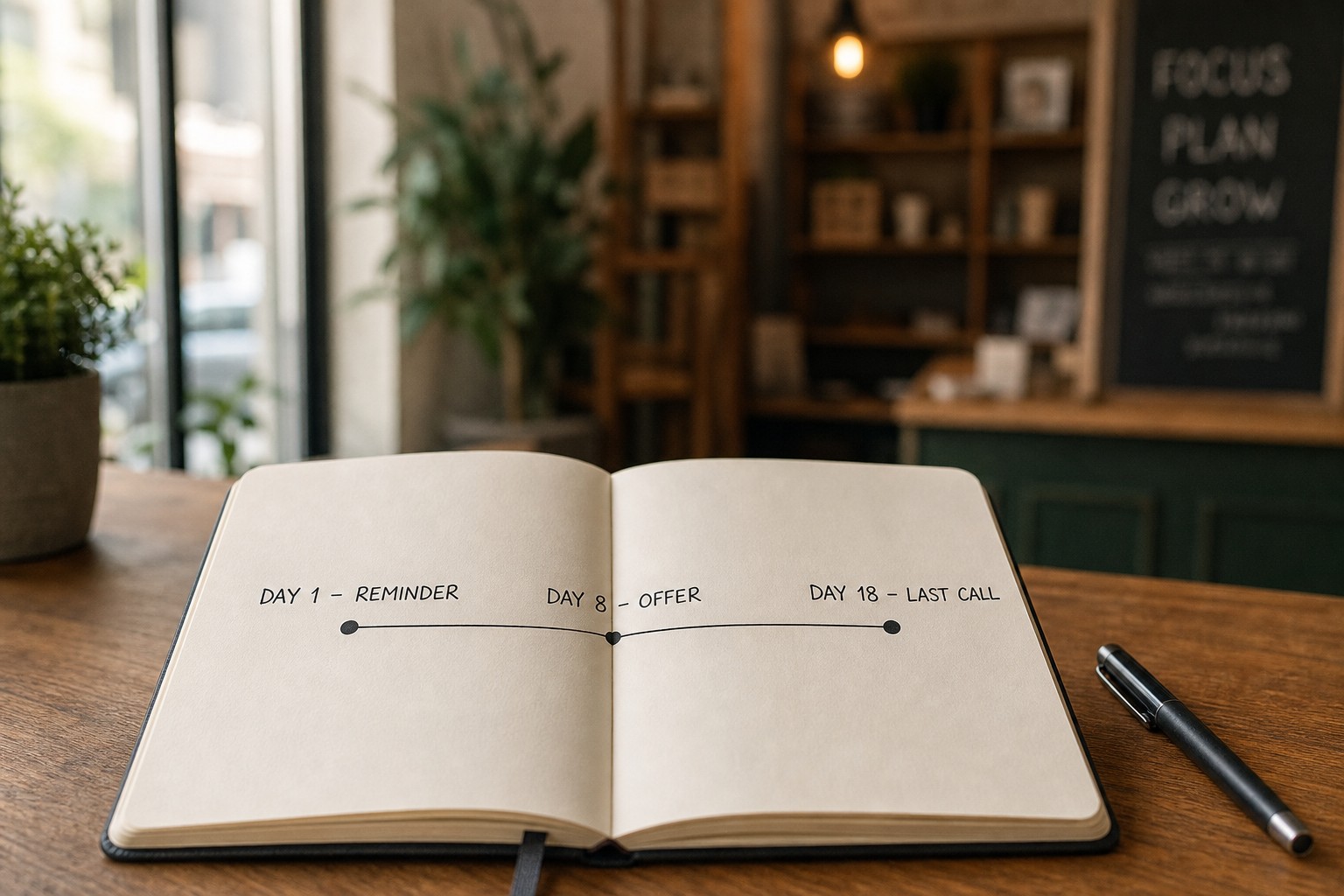
A single email or text rarely does the heavy lifting on its own. What tends to work far better is a short sequence, typically three touches spread across two to three weeks.
Here’s a sequence structure that works well for cafes and retail shops:
| Touch | Timing | Purpose | Tone |
|---|---|---|---|
| Touch 1 | Day 1 | Simple reminder, no pressure | Warm, casual |
| Touch 2 | Day 7-10 | Introduce the offer or incentive | Slightly more direct |
| Touch 3 | Day 14-21 | Last call, add urgency or expiry | Clear deadline, low pressure |
Each touch should build on the last rather than repeat it word for word. The first message opens the door; the second sweetens the deal; the third creates a reason to act now rather than “someday.”
Spacing matters as much as content. Send all three too close together and you look pushy; space them too far apart and the customer forgets the thread entirely. Two to three weeks total tends to hit the balance for most small businesses.
What Makes an Effective Win-Back Offer (Without Eating Your Margin)
The offer is where most small business owners either overcorrect (giving away too much) or undercorrect (offering something too weak to matter). A few principles worth following:
- Dollar amounts tend to feel more concrete than percentages. An offer like “$15 off your next visit” is easier to picture than an equivalent percentage discount.
- Size the offer to the lapse length. A 30-day-lapsed customer might just need a free add-on or small reward; a 90-day-lapsed customer may need a more meaningful discount to justify breaking their new habit.
- Protect your margin by tying the offer to a visit, not a giveaway. A free coffee with any purchase costs you far less than a blanket percentage off the whole basket.
- Set an expiry. Offers without a deadline get filed away and forgotten; a two-week window creates a reason to act.
For a cafe, this might look like a free pastry with any drink purchase for lapsed customers, rather than a straight 20% off everything. For a retail store, a fixed dollar credit toward a purchase over a certain amount protects margin better than a blanket sitewide discount.
The goal of a win-back offer isn’t to be the biggest discount they’ve ever seen from you. It’s to be just enough of a nudge to get them through the door again, where the actual product or service does the rest of the convincing.
Choosing the Right Channel: Push Notification vs Email vs SMS
Channel choice for a win-back campaign isn’t a matter of picking a favourite; it’s matching the channel to the stage of lapse and the urgency of the message.
- Push notifications work well for recently-lapsed customers and location-based reminders, particularly if you’re using geofenced alerts that trigger when someone’s nearby. They’re free to send and feel low-pressure, which suits the first touch in a sequence.
- Email is the workhorse for the full sequence. It’s low-cost and allows more detail than a push notification or text.
- SMS carries more weight and urgency, so it’s worth reserving for the final touch in a sequence, particularly for a time-limited offer with a hard deadline.
Many small businesses default to whichever channel is easiest to set up rather than what suits the message, which is understandable but leaves reactivation on the table. A system that supports free automated push notifications alongside email and SMS gives you the flexibility to match the channel to the moment without manually managing three separate tools.
Timing Your Win-Back Campaign for Maximum Response
Timing operates on two levels: when you trigger the campaign relative to a customer going quiet, and when during the week or day you actually send each touch.
On the trigger side, don’t wait too long. The moment a customer crosses your 30-day threshold is the right time to start the sequence, not three months later once they’ve fully moved on.
On the send-time side, a few practical notes for cafes and retail:
- Cafe win-back offers tend to land better sent in the late morning, ahead of a lunch or afternoon coffee decision.
- Retail win-back offers often perform better sent Thursday through Saturday, ahead of typical weekend shopping.
- Avoid sending the final urgency-driven touch too close to a public holiday or major local event, where inboxes are already crowded.
Reactivating a lapsed customer costs meaningfully less than acquiring a brand new one - Harvard Business Review’s widely-cited estimate puts new-customer acquisition at 5 to 25 times more expensive than retention. That gap alone justifies the small amount of planning it takes to get timing right.
Win-Back Message Examples for Cafes and Retail Businesses
Copy matters more than most small business owners assume. Below are example message frameworks you can adapt.
Cafe Example (3-Touch Sequence)
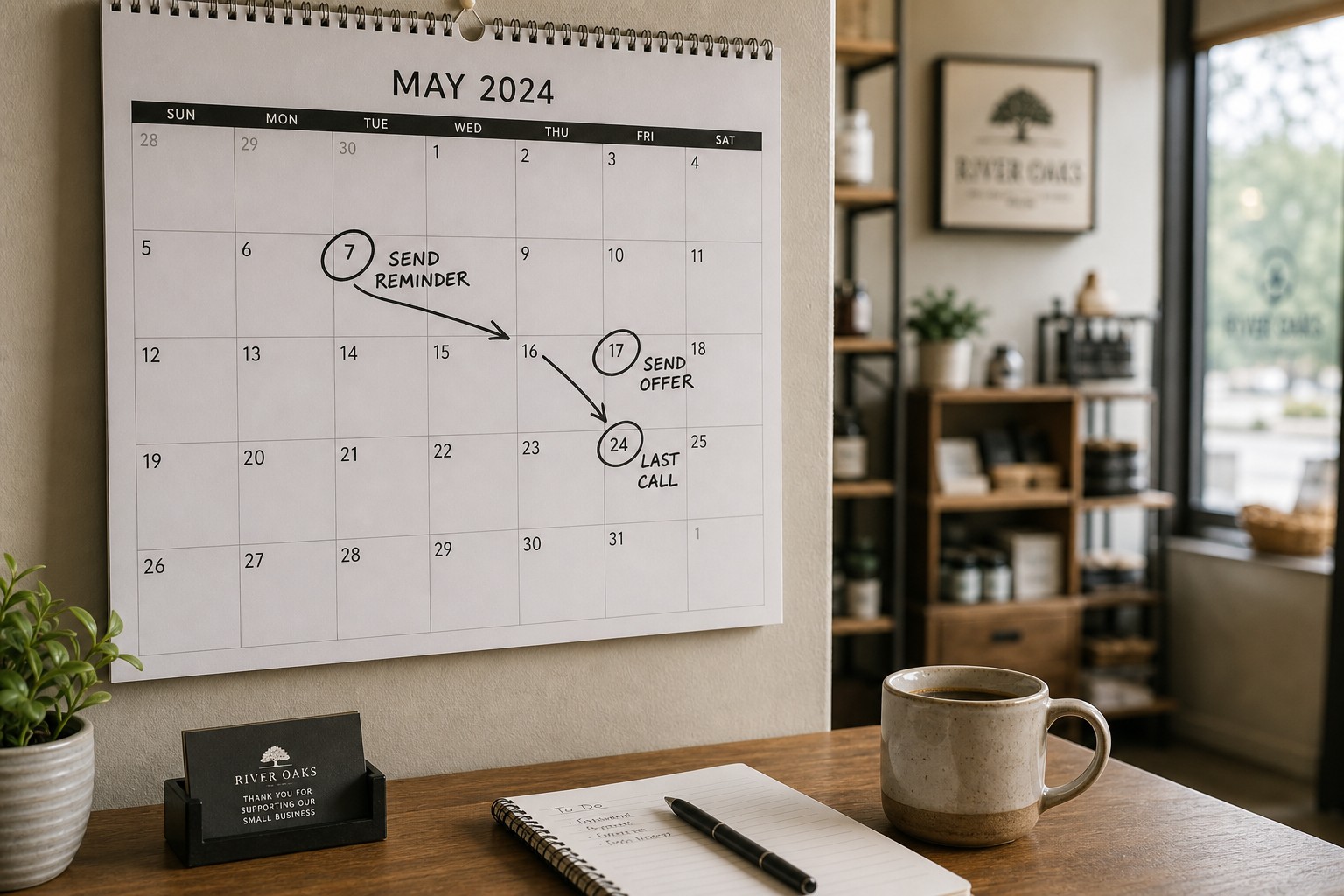
Touch 1 (Day 1, push notification): “Haven’t seen you in a while! We’ve still got your usual on the menu. Drop by this week?”
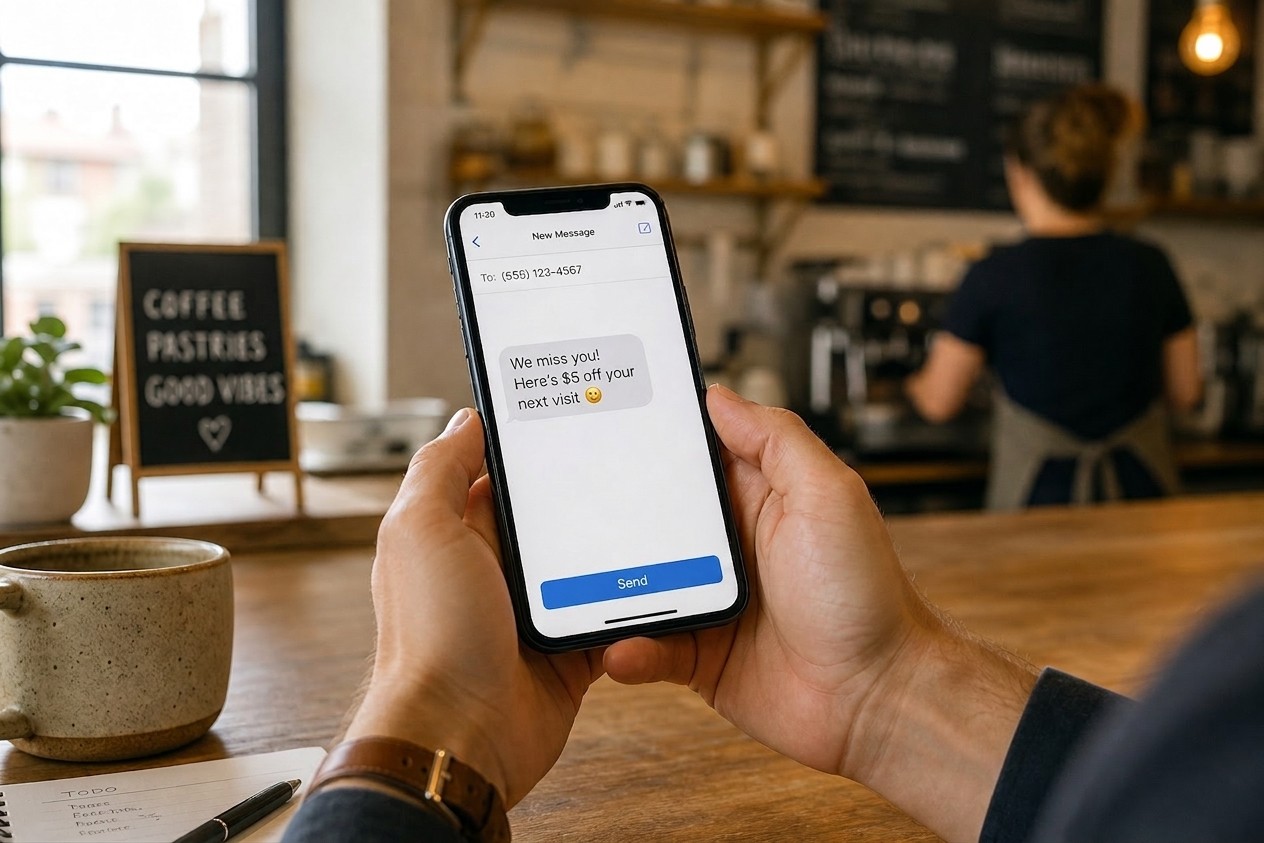
Touch 2 (Day 8, email): “We miss having you around. Here’s $5 off your next order, on us, valid for the next 14 days.”
Touch 3 (Day 18, SMS): “Last chance: your $5 credit expires Sunday. Come grab your favourite before it’s gone.”
Retail Example (3-Touch Sequence)
Touch 1 (Day 1, email): “It’s been a minute! Check out what’s new in store this month.”
Touch 2 (Day 10, email): “Come back and save $15 on your next purchase of $50 or more. Offer ends in 2 weeks.”
Touch 3 (Day 20, SMS): “Final reminder: your $15 credit expires Friday. Don’t miss out.”
Notice that none of these lean on generic phrases like “we value you as a customer.” They’re specific, short, and give the reader an obvious reason to act within a fixed window.
Measuring Whether Your Win-Back Campaign Is Working
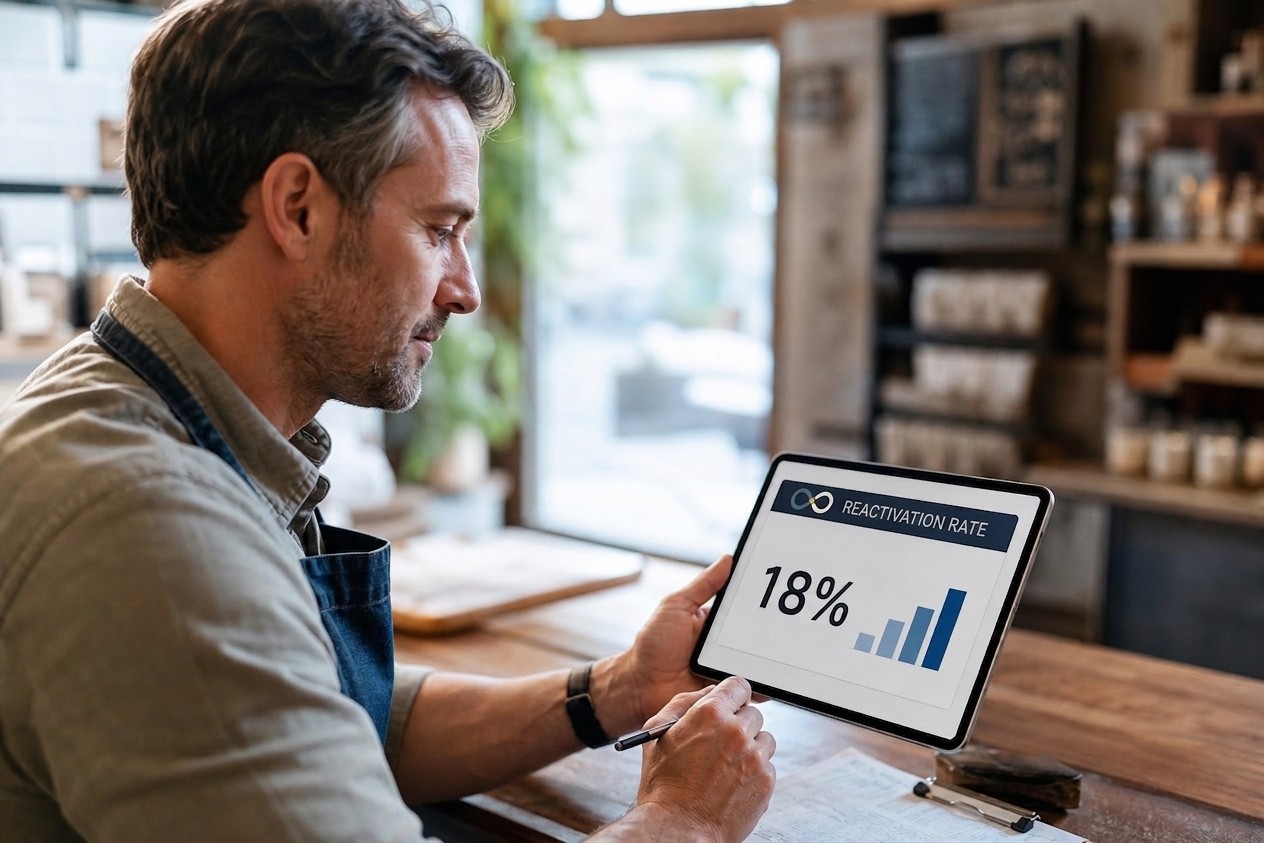
The main metric to track is reactivation rate: the percentage of targeted lapsed customers who make a purchase or visit again within a set window after the campaign runs.
Reactivation rate = (Number of lapsed customers who returned) ÷ (Total number of lapsed customers targeted) × 100
There’s no single authoritative industry benchmark for this figure - estimates in marketing literature vary widely, from the single digits up to 30%, depending heavily on the business, the offer, and the audience. Rather than chasing a specific percentage, treat your own first campaign as the baseline and track whether the number improves as you refine segmentation, timing, and offer size.
Other metrics worth tracking alongside reactivation rate
- Open rate per touch, to see whether your subject lines or push copy are getting noticed at all.
- Click-through rate, especially if you’re linking to an offer or booking page.
- Average spend on return visit, to check the win-back offer isn’t just bringing people back for the discount alone.
- Repeat rate after reactivation, since winning someone back once means little if they lapse again a month later.
If you want a deeper look at what happens to revenue over the full customer relationship once win-back efforts are factored in, our article on customer lifetime value covers how reactivated customers contribute to that number over time. Win-back is one piece of a broader system - see our complete guide to customer retention for small business for how it fits alongside loyalty programs, churn tracking, and repeat customer rate.
Automating Your Win-Back Campaigns So They Actually Run Consistently
The mechanics above work in theory, but the reason most small businesses don’t run win-back campaigns consistently is simple: nobody has time to manually check visit dates, build segments, and send three-touch sequences every week.
This is where automation earns its keep. A loyalty and retention system that automatically flags customers crossing a 30, 60, or 90-day inactivity threshold and triggers the right message at the right time removes the manual workload entirely.
Some of the pieces worth having in place:
- Automatic tracking of last visit or purchase date for every customer, without manual data entry.
- Pre-built segments for recently lapsed, mid-lapse, and long-lapsed customers.
- Automated push notifications and geofenced reminders that trigger without you lifting a finger.
- A loyalty mechanic that keeps reactivated customers engaged after they come back, so you’re not repeating the same win-back cycle every few months.
If you want to see what this looks like running against your own business, it’s worth booking a short demo to walk through the setup with a real person rather than piecing it together from guides alone. Plans that include this kind of automation, built-in CRM, and push notifications start from $79/month, with higher tiers unlocking more active promotions and geo-targeted push as your win-back needs grow.
Conclusion
A win-back campaign doesn’t need to be complicated, but it does need structure: segment by how long someone’s been gone, run a short sequence rather than a single message, size the offer to protect your margin, and pick the channel that matches the urgency of each touch.
Small businesses that put even a basic version of this in place tend to see meaningfully better reactivation than those sending one generic “we miss you” email and hoping for the best. If you’re ready to see how the segmentation, sequencing, and automation pieces come together in practice, explore how the process works or get in touch to talk through your specific setup.
Frequently Asked Questions
How long should a customer be inactive before we start a win-back campaign?
Most small businesses start their win-back campaign around the 30-day mark, since waiting longer means competing against habits the customer has already formed elsewhere. Starting a light-touch reminder at 30 days and escalating the offer at 60 and 90+ days tends to work better than a single trigger point.
What’s a good reactivation rate for a small business win-back campaign?
There’s no single reliable industry benchmark, and estimates in marketing literature vary widely. The most useful approach is treating your own first campaign as a baseline and tracking whether reactivation improves as you refine segmentation, timing, and offer size.
Should we offer a discount or a free item in a win-back campaign?
Specific dollar-amount offers, like $15 off, tend to feel more concrete than percentage discounts because they’re easier for the customer to picture. For cafes specifically, a free add-on tied to a purchase (like a free pastry with a drink) often protects margin better than a blanket discount.
How many messages should be in a win-back sequence?
A 3-touch sequence spread across 2 to 3 weeks is a solid default for most small businesses: a light reminder, followed by an offer, followed by a final urgency-driven message with a deadline. Sending everything in one message tends to underperform compared to this spaced-out approach.
Is SMS or email better for a win-back campaign?
Email works well for the bulk of the sequence because it’s low-cost and allows more detail, while SMS carries more urgency and suits the final, deadline-driven touch. Push notifications are useful for the first, low-pressure reminder, particularly if they’re geofenced to trigger when a customer is nearby.
Is running a win-back campaign worth it for a small cafe or retail shop?
Yes. Reactivating a lapsed customer typically costs several times less than acquiring a brand new one, and lapsed customers are generally more receptive to hearing from you again than most small businesses assume.
Can win-back campaigns be automated for a small business without a dedicated marketing team?
Yes - tools built around loyalty and retention can automatically segment lapsed customers and trigger the right message at the right time without manual work. Features like automatic CRM data capture and automated push notifications make it possible to run a consistent win-back campaign without a dedicated marketing hire.